Stureplan is the square in the middle of Nossebro, a small town in Västergötland, and most of it is a car park. In the middle of the car park is a hedged flower bed, and in the middle of the bed stand a pair of scissors 6.444 metres long: 280 kilograms of stainless steel with red handles, made by the municipality in 1994 to cut the ribbon when Storgatan reopened, listed by the Guinness Book in 1996 as the largest in the world, and mounted upright on the square in 2000 — where they can no longer cut, which is why the record has since moved on.
Print a square of Nossebro and everything in it is right except that. The streets are the streets, the ICA is the ICA, the hedged bed is a green wedge in a sand car park — and the thing the bed was laid out around is not there.
A point, not a building
Nothing has gone wrong. OpenStreetMap has the scissors mapped, and mapped correctly: a node tagged tourism=artwork, artwork_type=sculpture, name=Saxen, standing where they stand. What GeoFilament asks the map for is buildings — outlines with a footprint to extrude — and a point has no footprint, so the pipeline never fetches it and never sees it. The bed it stands in is tagged leisure=park, and a park is fetched, which is how the plate came to carry the bed and not the thing in it.
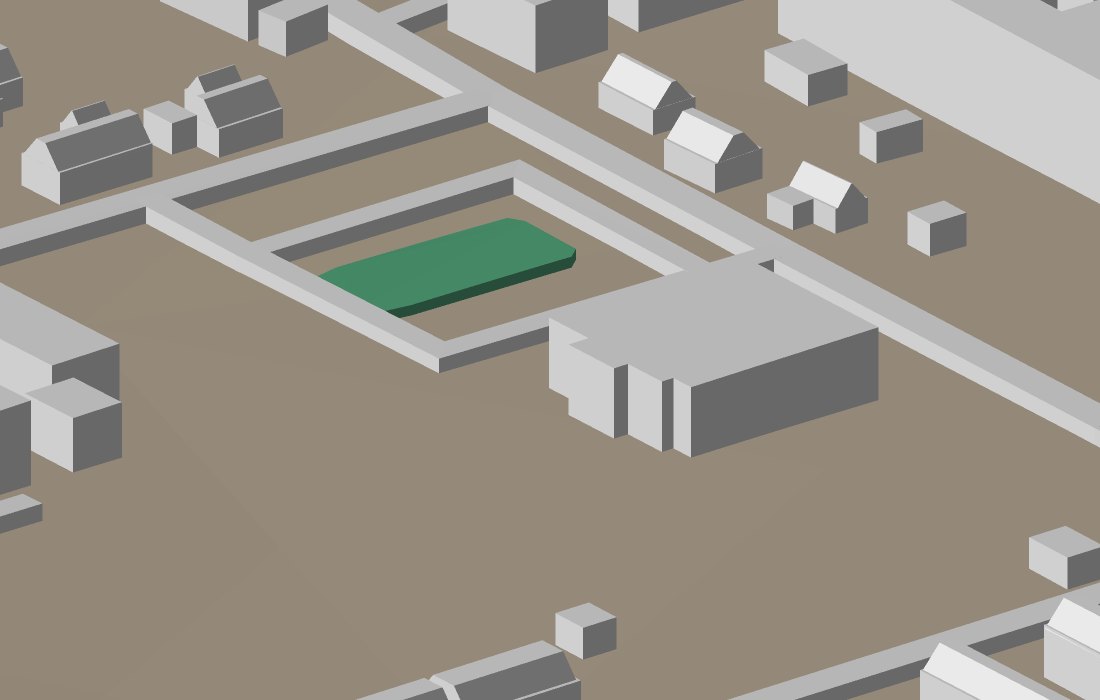
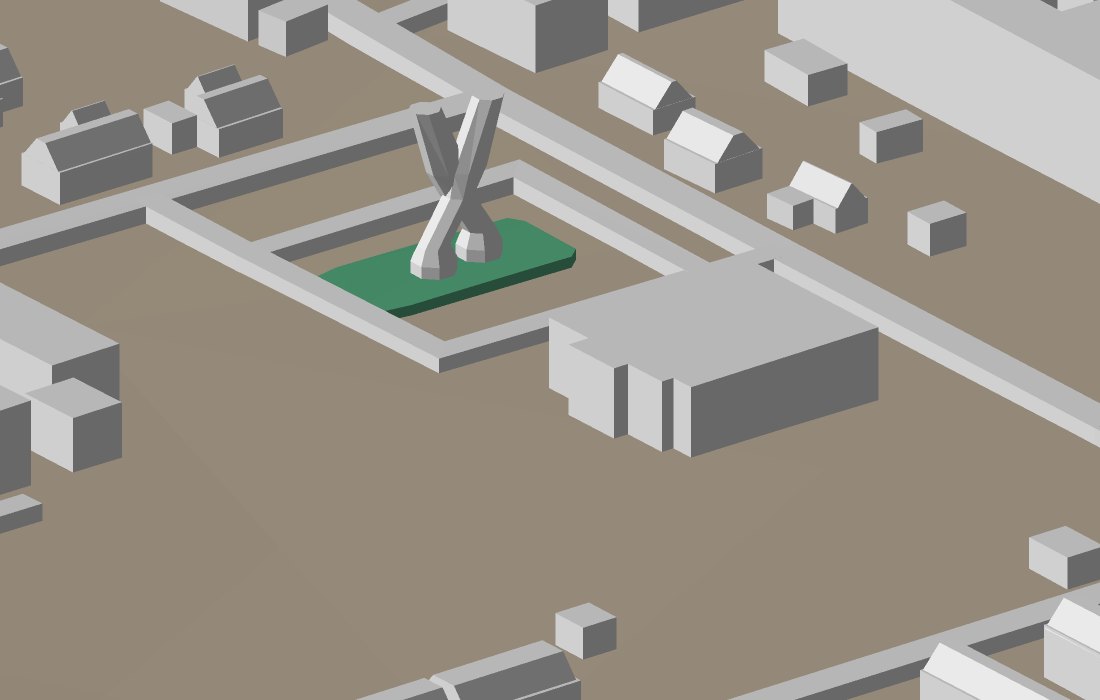
This is the case the monument post could not raise, because that post is about buildings the map has at the wrong shape. Here the map has the shape’s position and nothing else, and there is no tag that could carry a pair of scissors. So the scissors are drawn — a file in the same registry that draws the Eiffel Tower and the Colosseum, standing on the node’s own coordinate rather than on a footprint, and turned to the long axis of the bed, since a flat sculpture has to be told which way it faces.
Under the nozzle
At 1:5,000 the whole sculpture is 1.8 millimetres tall, with the studio’s height slider where it ships. Nothing that small can be drawn true, and the reason is a rule rather than a limit of care: every member of a drawn monument prints at least 0.9 millimetres wide, because a printer with a 0.4 mm nozzle cannot make a wall thinner than two of them, and a shape finer than that does not print finer, it prints as noise. The widest member of the scissors — a bow, 1.54 m across — is a third of the 4.5 metres that floor works out to at this scale.
What the floor does is fatten a member’s width and leave its centre alone. That one fact decides everything: a gap between two members exists on the plate only where their centres are more than 0.9 mm — 4.5 m — apart. In the real sculpture the widest gap anywhere is the 2.3 m between the two bows, so drawn honestly it came off the plate as a single spool with a pinch in it. No eye between the handles, no V between the blades, and no amount of drawing more carefully could put either there.
Drawn as a glyph
So the file draws what the ✂ glyph keeps when it has six pixels to keep it in: two loops, a crossing, and two blades that are broad where they leave the pivot and narrow to a point. Each number is set by what it buys. The loops are drums 6.5 m across on centres 9 m apart, because 1.3 mm is the first width that reads as fatter than a 0.9 mm shank and 9 m leaves half a millimetre of clear air between the two. The pivot is 10 m up, which is not a choice: a shank has to get from the top of its loop to the crossing on the axis, and it may lean at most 45° or it prints over air. The blades are 11.6 m long and open 54°, with a 6 m shoulder that prints at 1.2 mm and tapers to 0.9 at the tip — the only taper the floor allows.
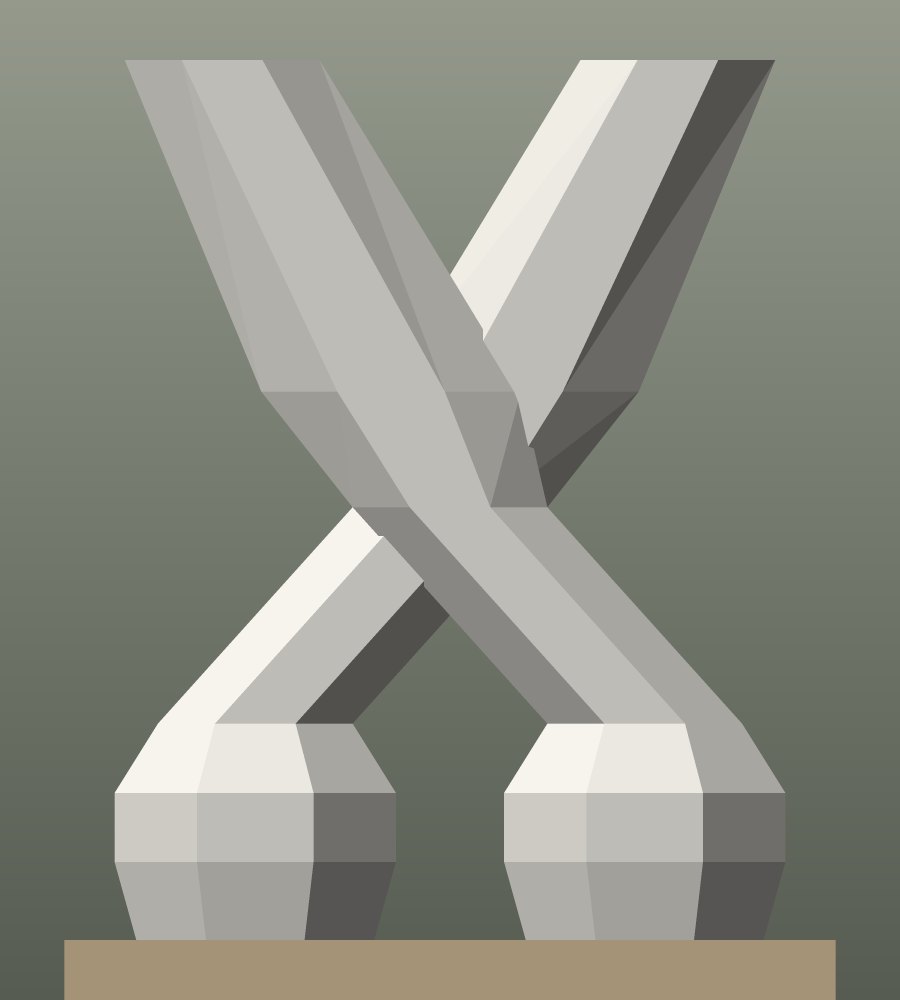
The cost is stated rather than hidden, and it is not small. The drawn pair stands 20.3 m where the sculpture stands 6.444 — three times life — so on the plate it is 5.7 mm and the tallest thing on Stureplan, when in life it is about as tall as the supermarket behind it. That is the same trade the registry made for a 3 m park gazebo, whose roof is drawn a size up because a gazebo that cannot overhang its own body is a shed; here it is made on every part at once, because here every part is under the floor and the subject is the relation between them.
Your town has one too
Most towns have a thing like this — a statue on the square, a fountain, a sculpture at the roundabout — and most of them are mapped exactly as Saxen is: a point, tagged as art, in a bed tagged as a park. None of them is a building, so none of them is on a plate until somebody draws it. The registry is authored by hand, one file per monument, and every file is held to the same three rules before it ships: nothing further than 45° from vertical, every gap crossed by an arch rather than a lintel, and nothing narrow left standing tall. If your town’s is missing, that is a gap in the queue rather than a limit of the thing.
Passing it on
The film at the top of this page is free to use, and so are the words below it. Press Copy and it is on your clipboard. The film itself, the vertical cut for a phone and both posters are in the press kit on the launch post.
Saxen reel — LinkedIn
Goes with the film at the top of this page. Upload the square cut natively rather than linking it.
Nossebro, a small town in western Sweden, built the world's largest pair of scissors: 6.444 metres of stainless steel, made in 1994 to cut the ribbon when the high street reopened, and listed by the Guinness Book in 1996.

OpenStreetMap has them — as a single point, tagged as artwork. And a point is not a building, so a 3D-printed plate of the town carried the flower bed they stand in and not the scissors.

Drawing them turned out to be an arithmetic problem rather than a modelling one. At 1:5,000 the whole sculpture is under two millimetres tall, and every member of a printed monument is at least 0.9 mm wide — two walls of a 0.4 mm nozzle. That floor fattens a width and leaves a centre alone, so a gap between two members exists only where their centres are more than 4.5 metres apart. The real bows are 2.3 m apart. Drawn true, the scissors printed as one spool with a pinch in it.

So they are drawn as the ✂ glyph: two loops 6.5 m across on centres 9 m apart, a crossing 10 m up, blades 11.6 m long open 54°. Three times life, 5.7 mm on the plate, and every gap prints.

The cost is stated in the file that draws it — the tallest thing on the square, where in life it is about as tall as the supermarket behind it. That is the trade for a landmark that is otherwise simply absent.

geofilament.mochi.is

Map data © OpenStreetMap contributors (ODbL)
Saxen reel — Instagram, TikTok
For the vertical cut. A link is not clickable there, so the address is said rather than linked.
A town in Sweden built the world's largest scissors. The map has them as a single point.

A point is not a building, so a 3D-printed plate of the town had the flower bed and not the scissors in it.

At this scale they are under two millimetres tall, and a printer cannot draw a wall thinner than 0.9 mm — so they are drawn as the ✂ glyph instead, three times life, with every gap wide enough to print.

Your town has one too. Find it, frame it, print it.

geofilament.mochi.is

#3dprinting #3dprint #bambulab #sweden #nossebro #sculpture #citymap #maps #cartography #makersgonnamake
One line
For a directory entry, a newsletter blurb or an app-store subtitle.
GeoFilament draws the landmark your town is known for by hand, even when the map has it as a single point.